30 Days Nigerian Hypertension Meal Plan
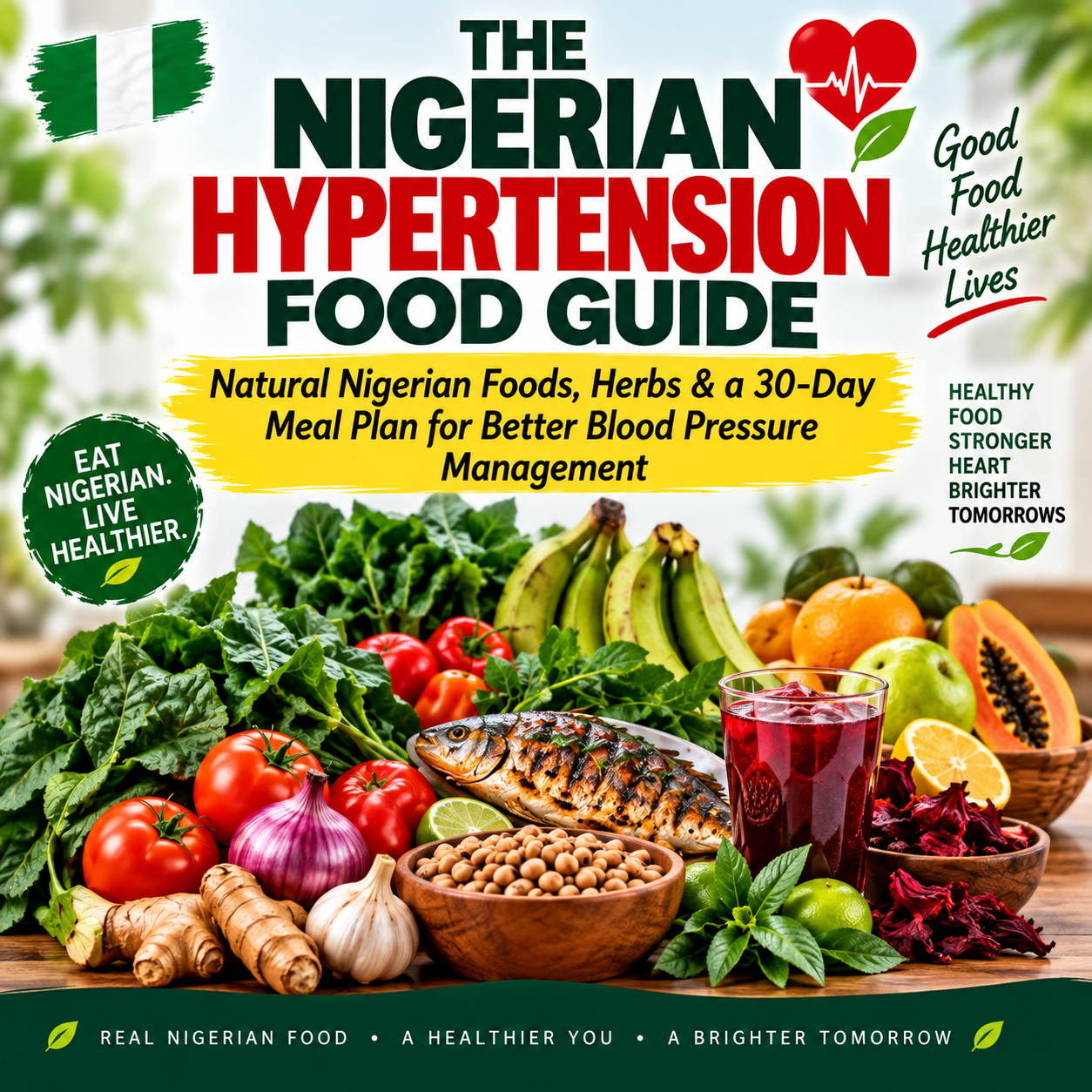
THE NIGERIAN HYPERTENSION FOOD GUIDE
Natural Nigerian Foods, Herbs & a 30-Day Meal Plan for Better Blood Pressure Management
What if eating for better blood pressure didn't mean giving up the Nigerian foods you love?
Rice. Beans. Plantain. Fish. Soups. Ugu. Okro. Moi-moi. Sweet potatoes. Fruits.
You don't necessarily need to abandon Nigerian food.
You need to learn how to build your plate differently, reduce excess sodium, choose better ingredients, control portions and make healthier meals part of your everyday lifestyle.
Introducing:
THE NIGERIAN HYPERTENSION FOOD GUIDE
A practical Nigerian guide to eating better, reducing excessive salt, using herbs and spices wisely, and building heart-conscious meals with familiar foods.
❤️ IF YOU'RE CONCERNED ABOUT HIGH BLOOD PRESSURE, THIS GUIDE IS FOR YOU
High blood pressure can exist without obvious symptoms, which is why regular blood-pressure measurement matters. The guide explains hypertension in simple language and connects the medical information to practical everyday food choices.
But here's the challenge:
You may know that you should "eat healthy."
You may have been told to reduce salt.
You may have heard that vegetables and fruits are good for you.
You may even have heard about DASH.
But...
What exactly should you eat tomorrow morning?
What Nigerian foods should you choose?
How much rice, swallow or plantain should be on your plate?
What can you use instead of excessive stock cubes and salt?
Which herbs and spices can help you create flavour without depending on salt?
How do you turn all this information into an everyday Nigerian eating pattern?
This guide was created to help answer those questions.
🌿 FINALLY, A HYPERTENSION FOOD GUIDE BUILT AROUND NIGERIAN FOOD
You don't need to survive on unfamiliar foreign recipes.
You don't need expensive imported "superfoods."
You don't need to completely abandon your traditional meals.
The guide shows how DASH principles can be adapted to foods Nigerians already know and can realistically buy and prepare.
🍽️ DISCOVER THE NIGERIAN HYPERTENSION PLATE
One of the simplest concepts in the guide is the Nigerian Hypertension Plate.
🥬 50%
VEGETABLES
Make vegetables a major part of your meal.
Think:
Ugu • Waterleaf • Ewedu • Okra • Spinach • Cabbage • Carrots • Tomatoes • Cucumber • Garden eggs
🐟 25%
PROTEIN
Choose options such as:
Fish • Beans • Chicken • Moi-moi • Eggs • Lentils
🍚 25%
WHOLE OR MINIMALLY PROCESSED CARBOHYDRATE
Choose appropriate portions of:
Brown rice • Unpolished rice • Oats • Sweet potato • Unripe plantain • Whole-grain bread
🍌 ADD FRUIT
Banana • Pawpaw • Orange • Watermelon • Guava • Pineapple
💧 DRINK WATER
Make water your primary everyday drink.
🧂 REDUCE
Salt and high-sodium ingredients.
The guide presents this as a simple visual tool for improving meal balance—not as a rigid medical prescription.
🧂 THE SALT PROBLEM MOST PEOPLE DON'T SEE
You may think:
"I don't use much salt."
But sodium doesn't only come from the salt shaker.
It can also come from:
- Stock cubes
- Seasoning powders
- Processed meats
- Salted fish
- Instant noodles
- Packaged foods
- Sauces
- Snacks
- Restaurant meals
The guide explains where sodium hides in everyday Nigerian meals and introduces practical ways to reduce excessive sodium without making your food tasteless.
You'll also learn the "Taste Before Salt" Rule and how to build flavour using onion, garlic, ginger, tomatoes, peppers, herbs, spices and citrus.
🌿 WHAT ABOUT NIGERIAN HERBS?
This is where the guide takes a different approach.
Instead of making exaggerated claims like:
❌ "This herb will cure hypertension."
It teaches you how to use herbs and spices more responsibly.
You'll explore ingredients such as:
🧄 Garlic
🫚 Ginger
🌿 Scent Leaf
🌱 Moringa
🌿 Lemongrass
🟡 Turmeric
🌶️ Black Pepper
🧅 Onion
🌺 Hibiscus/Zobo
🌿 Bitter Leaf
🌿 Ugu
The guide distinguishes between using herbs as food/flavouring ingredients and taking concentrated herbal supplements, including important safety considerations.
🥗 DISCOVER THE NIGERIAN FOODS THAT CAN FIT INTO A HEART-CONSCIOUS EATING PATTERN
The guide takes you through familiar Nigerian foods and shows practical ways to use them.
VEGETABLES
Ugu, waterleaf, ewedu, okra, spinach, cabbage, carrots, tomatoes, garden eggs and cucumber.
FRUITS
Banana, pawpaw, oranges, watermelon, guava, pineapple and avocado.
BEANS & LEGUMES
Beans, moi-moi, lentils and chickpeas.
WHOLE & MINIMALLY PROCESSED CARBOHYDRATES
Oats, brown rice, unpolished rice, sweet potatoes, unripe plantain and whole-grain bread.
PROTEINS
Mackerel, sardines, fresh fish, chicken and eggs.
The guide doesn't simply list these foods—it explains practical ways to incorporate them into Nigerian meals.
🍛 GET PRACTICAL NIGERIAN MEAL COMBINATIONS
Instead of wondering what a healthier Nigerian plate should look like, you'll find practical combinations such as:
🍚 Brown rice + vegetables + grilled mackerel
🫘 Beans + boiled unripe plantain + vegetables
🥣 Moi-moi + vegetables + fruit
🥣 Oats + banana + unsalted groundnuts
🍠 Sweet potato + boiled egg + vegetables
🥘 Okro soup + fish + moderate swallow
🥬 Vegetable soup + fish + moderate swallow
🍚 Brown rice + beans + vegetables
🍗 Grilled chicken + sweet potato + salad
🐟 Fish pepper soup + vegetables + moderate carbohydrate
These examples are designed around the guide's central principle:
You don't have to eliminate Nigerian food. You need to learn how to balance it.
🔄 DISCOVER THE "SWAP ONE THING" METHOD
You don't have to completely transform your diet overnight.
The guide gives you a simple way to begin.
WEEK 1
Swap sugary drinks → Water
WEEK 2
Reduce added salt
WEEK 3
Add vegetables to lunch and dinner
WEEK 4
Replace some refined carbohydrates with whole/minimally processed alternatives
WEEK 5
Increase beans and fish
WEEK 6
Reduce highly processed foods
The philosophy is simple:
Small changes that become habits are often more sustainable than extreme diets.
📖 WHAT YOU'LL DISCOVER INSIDE
PART ONE
Understanding Hypertension
Learn:
- What hypertension actually means
- Why high blood pressure can be a "silent" condition
- How to understand your BP numbers
- What can raise blood pressure
- The connection between salt, sodium and blood pressure
- Why monitoring matters
The guide also explains that hypertension management may require lifestyle changes and medication when prescribed.
PART TWO
The Nigerian Hypertension Plate
Learn how to:
- Build a balanced Nigerian plate
- Increase vegetables
- Choose better proteins
- Make smarter carbohydrate choices
- Reduce sodium
- Make water your default drink
- Create healthier versions of familiar Nigerian meals
PART THREE
Nigerian Foods for Blood Pressure Management
Explore:
- Nigerian vegetables
- Nigerian fruits
- Beans and legumes
- Whole/high-fiber carbohydrates
- Healthy protein sources
- Better cooking methods
- Healthier fats
- Foods to reduce
The guide emphasizes the overall eating pattern rather than a single "miracle" food.
PART FOUR
Nigerian Herbs, Spices & Natural Wellness Support
Learn about:
- Garlic
- Ginger
- Turmeric
- Hibiscus/Zobo
- Moringa
- Scent leaf
- Lemongrass
- Ugu
- Bitter leaf
- Clove
- Cinnamon
- Black pepper
- Onion
And importantly, learn the difference between food-based use and concentrated herbal supplementation.
PART FIVE
The Salt & Sodium Reset
Learn how to identify hidden sodium and create flavour without relying heavily on salt.
You'll discover practical strategies involving:
Onion + Garlic + Ginger + Tomatoes + Pepper + Herbs + Spices + Citrus
instead of simply adding more salt.
PART SIX
The 30-Day Nigerian Meal Plan
A practical framework for putting the principles into action using familiar Nigerian foods.
👨👩👧👦 WHO IS THIS GUIDE FOR?
This guide is ideal for:
✅ Adults concerned about their blood pressure
✅ People who have been advised to reduce sodium
✅ Nigerians looking for practical heart-conscious meal ideas
✅ Families wanting to make healthier Nigerian meals
✅ People who want to understand the DASH approach in a Nigerian context
✅ People who want to reduce their dependence on highly processed foods
✅ Anyone who wants a practical framework for making better everyday food choices
🚫 THIS GUIDE IS NOT FOR PEOPLE LOOKING FOR A "MIRACLE CURE"
If you're looking for:
❌ A magic herb
❌ A guaranteed cure
❌ A way to replace your prescribed medication
❌ A one-food solution
This is not that kind of book.
Instead, this guide teaches a more sustainable approach:
FOOD + FLAVOUR + PORTION CONTROL + LOWER SODIUM + MOVEMENT + MONITORING + APPROPRIATE MEDICAL CARE
The guide explicitly states that no single Nigerian food or herb should be presented as a cure for hypertension.
❤️ YOUR KITCHEN CAN BECOME PART OF YOUR HEALTHIER LIFESTYLE
Imagine opening your kitchen and knowing:
What vegetables should I eat?
What protein should I choose?
How much carbohydrate should I put on my plate?
How can I reduce the salt?
What can I use instead of excessive seasoning cubes?
Which Nigerian foods can fit into my eating pattern?
How can I make healthier meals without abandoning the food I grew up eating?
That's what this guide is designed to help you do.
📘 GET THE NIGERIAN HYPERTENSION FOOD GUIDE TODAY
THE NIGERIAN HYPERTENSION FOOD GUIDE
Natural Nigerian Foods, Herbs & a 30-Day Meal Plan for Better Blood Pressure Management
What you get:
✅ Complete digital guide
✅ Nigerian Hypertension Plate method
✅ Nigerian food guide
✅ Herbs & spices guide
✅ Salt & Sodium Reset
✅ Practical meal combinations
✅ 30-Day Nigerian Meal Plan
✅ Food selection tips
✅ Portion guidance
✅ Practical checklists
Instant Digital Download
Read it on your:
📱 Phone
💻 Laptop
📲 Tablet
🎯 START EATING WITH A PLAN
You don't need to wait for the "perfect" time.
You don't need to throw away your Nigerian recipes.
You don't need to become a nutrition expert.
You simply need to start making better choices—one meal at a time.
🔥 GET YOUR COPY NOW
THE NIGERIAN HYPERTENSION FOOD GUIDE
Natural Nigerian Foods, Herbs & a 30-Day Meal Plan for Better Blood Pressure Management
[GET INSTANT ACCESS NOW]